
PAY RUN
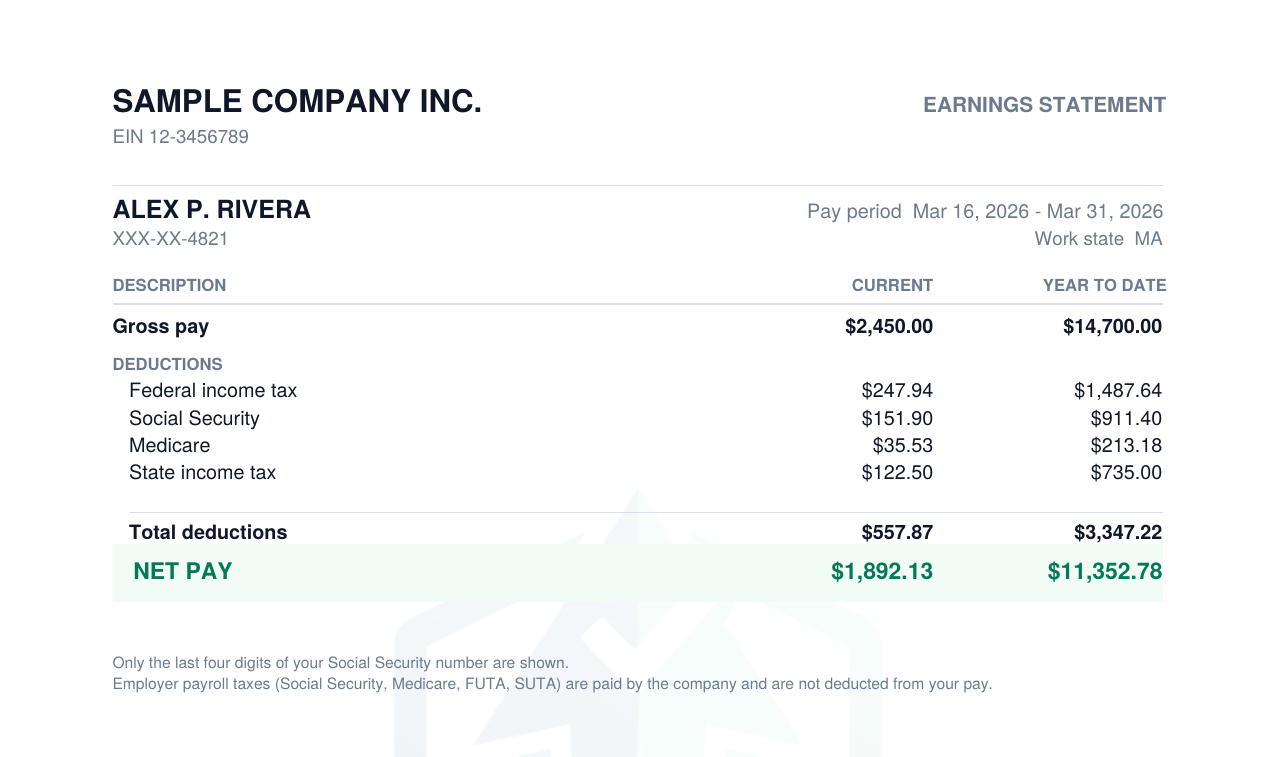
Pay runs & pay stubs
Companies and employees through to the pay run, in one flow. Stubs come out as one combined PDF per company and file straight into the client’s documents.
- ✓Weekly, biweekly, semimonthly, monthly, annual — and irregular, for companies with no schedule at all
- ✓Pre- and post-tax deductions — 401(k), health, HSA, garnishment. Each is exempt from a different set of taxes
- ✓Overtime at the FLSA regular rate — not the base hourly rate, but all straight-time pay ÷ hours for that workweek
- ✓Stubs are English, one page, last four digits of the SSN only — this is paper an employee takes to a lender
- ✓Turn the client notification off to backfill past periods — filing last year’s runs won’t ring their phone 24 times
- ✓Runs you already sent are marked in the list — filing the same period twice doubles your 941 and W-2
CHECKS
Check printing
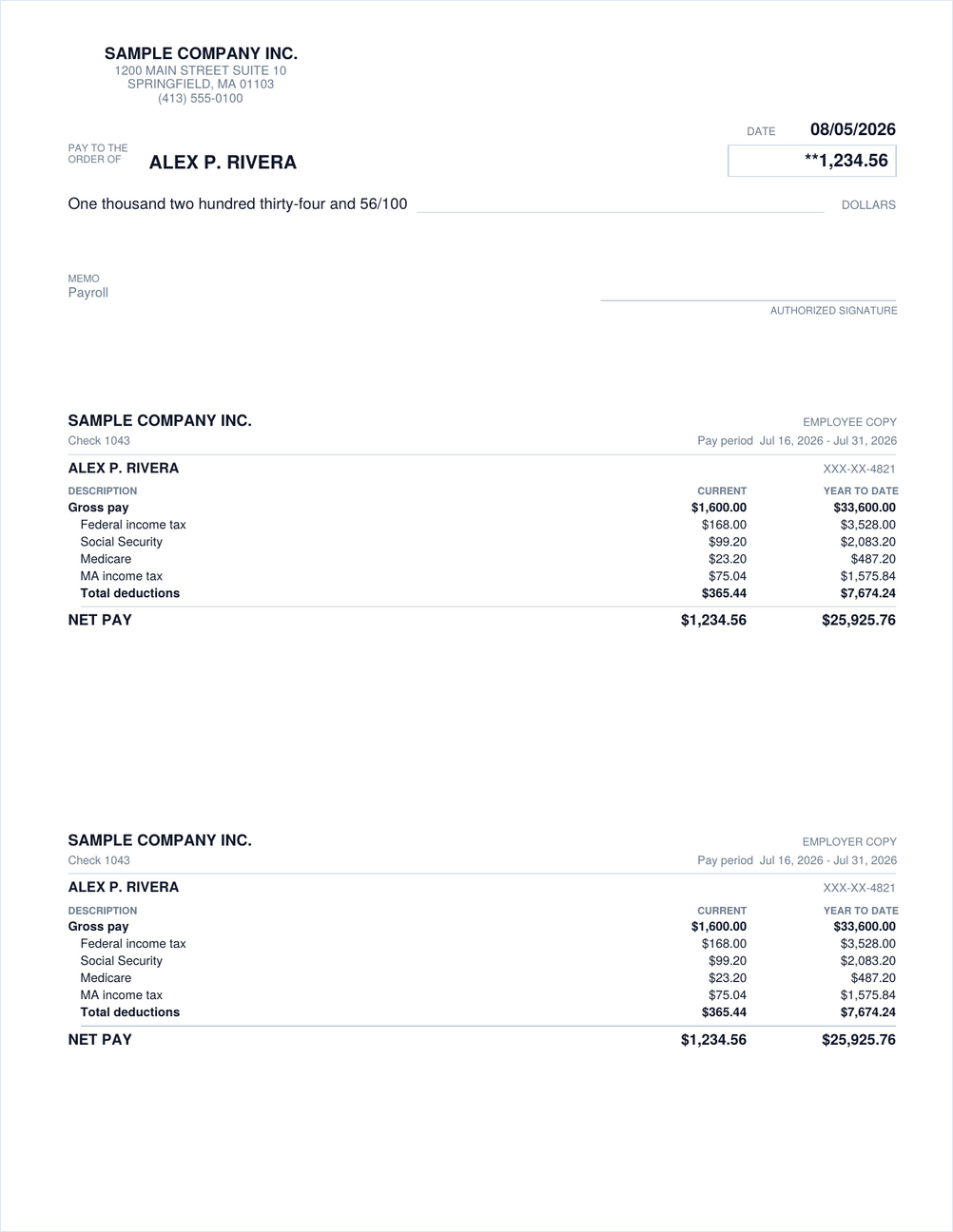
We print onto the check stock your client left at your office. We don’t make up a bank number — it’s already on that paper.
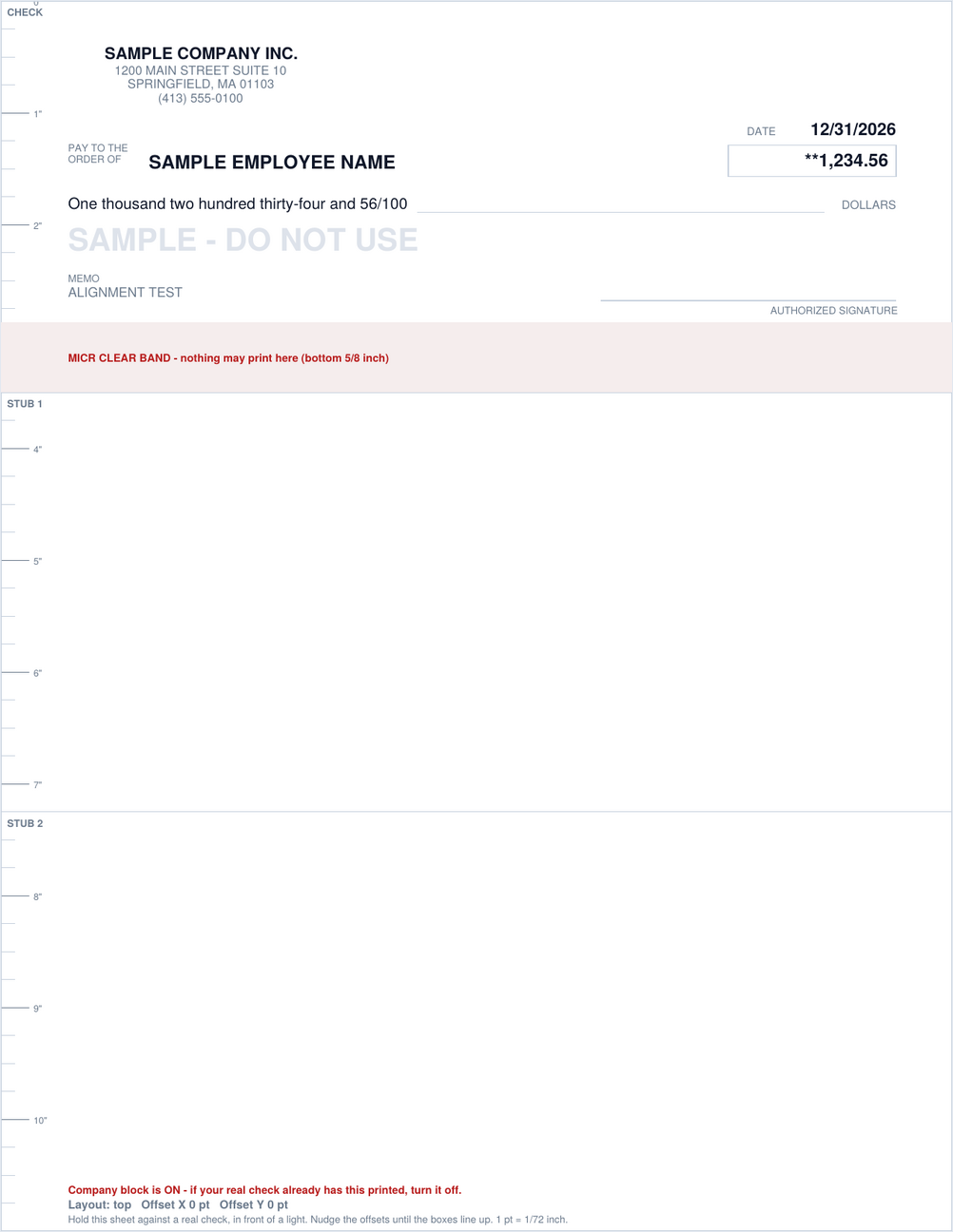
- ✓All three stock formats — check on top (the payroll standard), middle, bottom. Match whatever their bank sent
- ✓An alignment test page — print it on plain paper, hold it against a real check, nudge in 1/72-inch steps
- ✓The two stubs are the pay statement — one sheet and you’re done
- ✓The written amount and the numbers come from one place — banks read the written line first
- ✓Check numbers never go backwards — reusing a voided number breaks your bank reconciliation
- ✓The same run can’t be issued twice — the database stops an employee being paid twice over
- ✓Void a misprinted check in the register — the record stays and the number is never reused
FILINGS
941 · W-2 · 940 · state filings
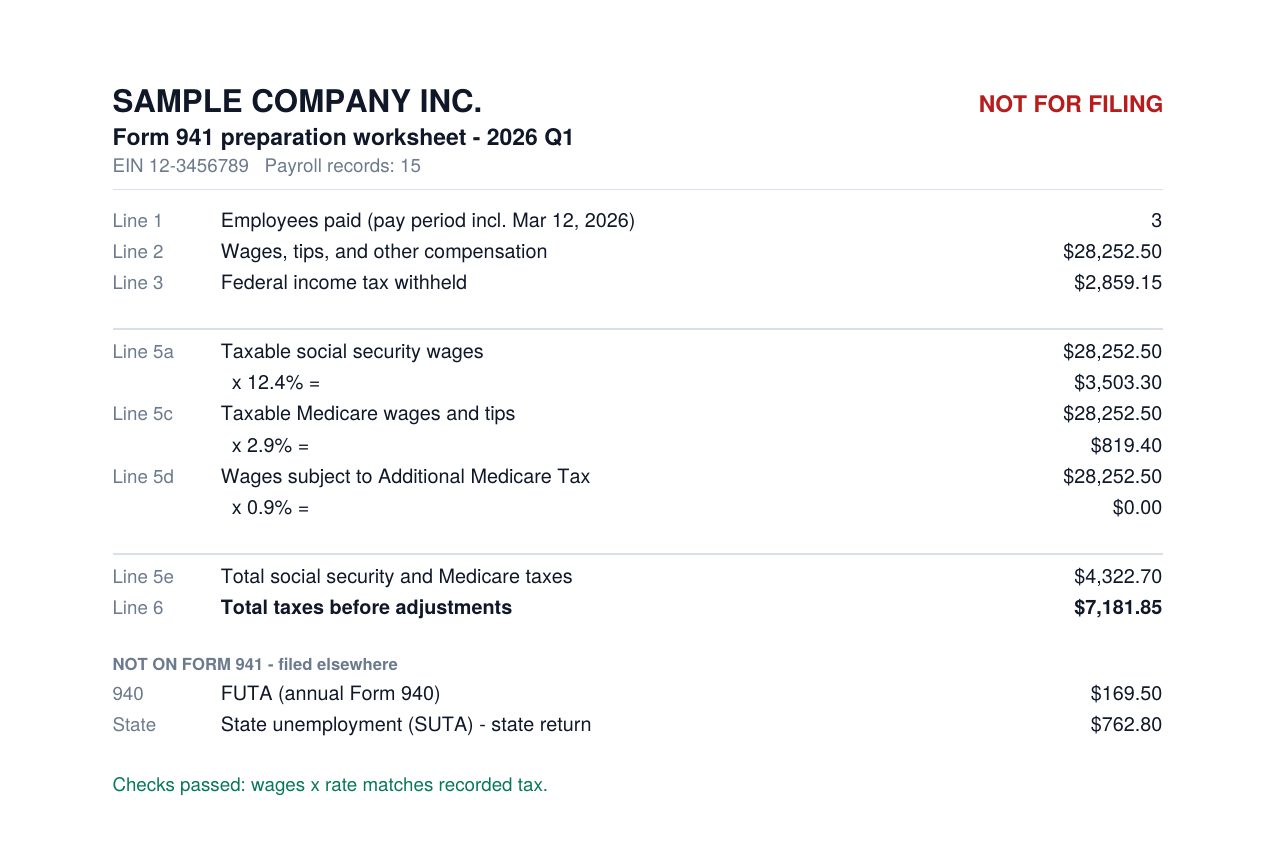
Totals for your quarterly and annual filings, as worksheet PDFs.
- ✓941 — quarterly totals plus the monthly liability breakdown (Line 16 · Schedule B)
- ✓W-2 — per-employee worksheet. Box 1, 3 and 5 differing from each other is correct (pre-tax deductions)
- ✓940 — annual FUTA. Line 5 is the excess over $7,000 per employee, not for the company as a whole
- ✓State quarterly — withholding, SUTA, monthly headcount: the values every state form asks for
- ✓Taxable wages are stored when they’re calculated — never back-solved from the tax amounts
- ✓Everything keys off the pay date — pay 12/21–1/3 on 1/8 and that payroll belongs to the next year
DEPOSITS
Deposit deadlines
A 941 is quarterly, so you notice when it slips. Deposits come due every payroll, and one day late carries a penalty.
- ✓Monthly or semiweekly, decided from the lookback period — and we show you the amounts behind that decision
- ✓Semiweekly due dates are set by the weekday — Friday payroll gets 5 days, Tuesday gets 3
- ✓Federal holidays are computed as rules — in 2026 July 4th falls on a Saturday, so July 3rd is the holiday
- ✓The $100,000 next-day rule beats the schedule. From that day you’re semiweekly, and it isn’t retroactive
- ✓Under $2,500 for the quarter means no deposits — it goes with the 941
- ✓We do not pay anything. This is a calendar.
STATE RATES
All 50 states and DC · rates belong to the firm
SUTA is an experience rate that differs per employer — there is no way for us to know it. The state mails each company its own notice.
- ✓We seed a reference value; your firm confirms it
- ✓Editing a rate clears the confirmation — so a changed number never rides on an old approval
- ✓Unconfirmed rates still get applied, with a warning — payroll has to go out
- ✓Which is why states we never coded still work
- ✓Type 0.9 into a rate and we ask whether you meant 0.9% (0.009)
SSN
Employee SSNs kept apart and encrypted
Payroll changes what this product holds — the Social Security numbers of your clients’ employees, third parties, in structured form.
- ✓A separate table — listing employees never drags SSNs along with it
- ✓Encrypted server-side with AES-256-GCM, and the key is not in the database
- ✓Screens only ever receive the last four digits — the full value is never in the browser to begin with
- ✓Revealing the full value takes real two-factor auth and leaves an audit record
- ✓Never sent to document AI — there is no path out of the system
- ✓Pay stubs print the last four digits only
🛡 Curious how the documents are protected?
Explore the security architecture →